Making Art That Fits Your Life (Instead Of Fitting Your Life To Your Art)

What do I mean by making art that fits your life?

A while ago, I wrote about the cycle of burnout that I’ve experienced by trying to achieve too much in too short a space of time. I took a quote from that post and put it on Instagram:
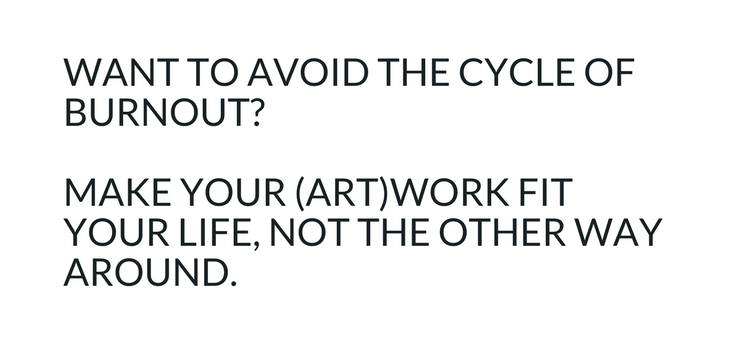
Want to avoid the cycle of burnout? Make your (art)work fit your life, not the other way around.


Another artist commented, “Ok. What does that look like?”


Fair question! Here’s what it looks like for me:


My circumstances limit me, but that’s ok – they also make me

When I dove back into fine art by resuming my degree, I was overwhelmed with how much “catching up” I had to do in order to get back to where I would have been a decade before. I didn’t have many gallery shows to put on my art cv, and I couldn’t apply for residencies as I was a single parent. Every job, opportunity or event I applied for had to fit in around the school run, vacation times and babysitters.


I was anxious to get things right, so I did try to hit the ground running after I graduated – I took my son to school and drove for hours to a stately home where there was a callout for a site-specific commission. After the tour and presentation, I raced back to the school to pick my son up. It was an exhausting day… and ultimately I didn’t get the commission. Of course, I was disappointed, but in hindsight it was clear that the opportunity was just that bit too far away for me to realistically manage.


For a long time I seemed to come across exhibition callouts, commissions, jobs and residencies that I couldn’t do. I kept on seeing the residencies, unpaid internships, weekend work, socially engaged practice commissions, day-long networking meetups and other opps that I just wasn’t cut out for. Most of it came down to the fact that I was a single parent, and that was not going to change.


Eventually I came to see that I was defining success in terms of recreating what my career would have looked like if I’d never dropped out of art school, moved across the Atlantic and had a child. But if none of that had ever happened, I wouldn’t be me today. I would never trade having my child for anything, so why should I compare my life with him to a life without?


I believe that many women face the same situation, as women still bear the primary responsibility for childcare in most households and experience the physical interruption of their careers when they have children. Of course, there are some men who find themselves in a similar situation as well. What I’m suggesting is not to deny oneself the right to aspire to ambitious projects or work, but to accept the fact that your limitations are not necessarily negative, just because it doesn’t fit the picture that you may expect.


Circumstances that limit us can be seen as parameters in which to function and perhaps flourish. Of course, if something is within your power to change, and you want to change it, then do it! Shortly after my experience with the failed commission bid, I moved to London – a pretty big move for my family – to work and study. It meant that I seriously stretched the boundaries of my limitations and ultimately, I gained a lot from it.

Looking at what I could do instead of what I could not

Unpaid internships – I had a child to care for, so no thanks. Weekend work – no childcare and no desire to miss out on all that time with my son. Networking – only during certain hours. Socially engaged art and workshops – I had no experience and frankly, no real interest in them.

I felt as though I was facing a brick wall of “no”. Fast forward several years and I have very different circumstances, and with them a different set of limitations… but I also have a lot more contentment than I used to, and that’s integrated with focusing on my opportunities. Seizing the opportunities that were available to me meant I gave a lot of energy to work that I could do from home, and it led to the creation of my tiny online empire!


Now, I sell my art on Etsy, run several blogs and work part-time in art education. I’ve also started to develop a course to help artists who feel a bit derailed by life’s limitations, especially financial limitations. You can find out more about that over on artandmoney.co.uk.

I’m a lot happier and a lot more productive because of creating the right environment in which to make my work – making the work that fits my life!
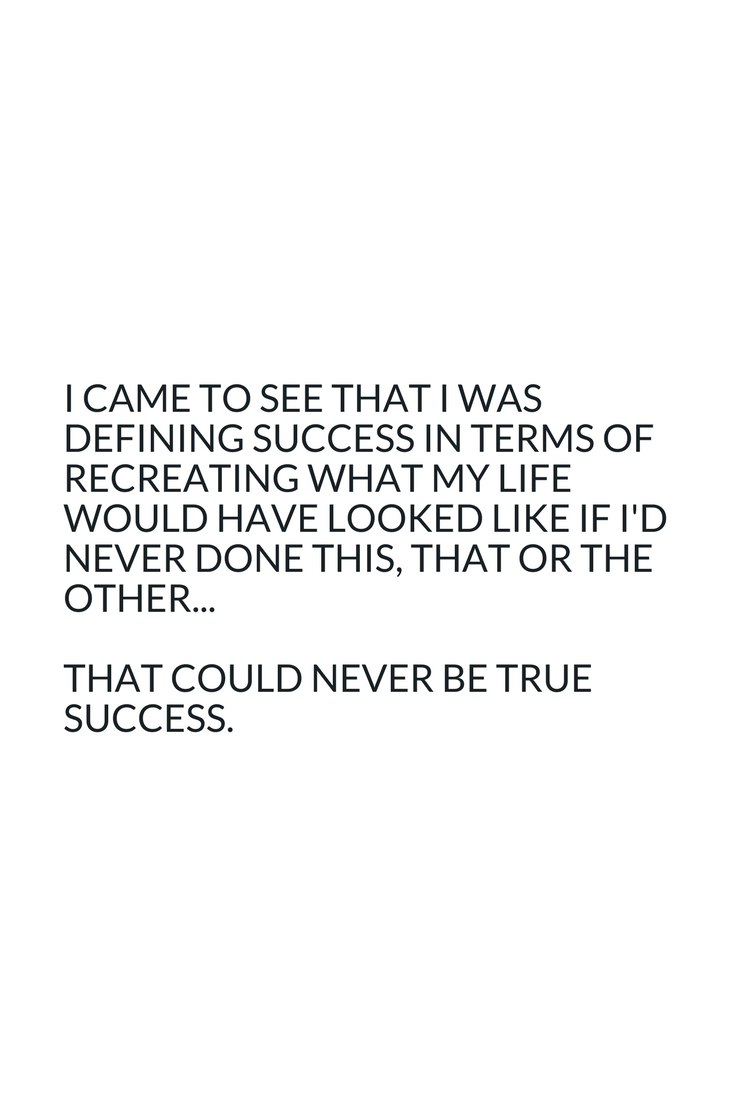
Defining success in terms of what recreating what you could have done in the past can never be true success.Make art that fits your life, instead of trying to make your life fit your idea of art.Make art that fits your life, instead of trying to make your life fit your idea of art.

Is Art A Job Or A Joy? Why Romanticising Artists’ Work Is Harmful

Romanticising artists’ work is harmful

“Painting is not a job, it’s a joy.”

So said Jonathan Jones in a review of Rose Wylie’s show at the Serpentine Gallery, Quack Quack. This stuck with me.

Jones was getting ahead of the reaction to Wylie’s naïve-style work, saying that, in the UK, we need more of Wylie’s type of work to shake us up a bit, because we “still expect painters to do a proper, hard-working job.” The art critic proclaiming that artists’ work transcends real work does us a small favour and a huge disservice at the same time.

The favour is that it acknowledges the magic inherent in art and the process of creating art, and it’s in that magic that the true value of art is born.

The disservice lies in the implication that creating art is not real work. Thanks to this kind of attitude, we can carry on romanticising artists and their work, and expecting them to exist in a moneyless bubble where they waft around at their joy instead of work at their jobs.

The idea that artists don’t have “real” jobs is destructive in two directions: it damages the public’s perception of working artists and encourages those who refuse to pay artists for their work, and it damages emerging artists’ perceptions of themselves, causing them to hold back from investing the time and care their practice requires.

The hypocrisy of art and money

Of course you can make art and make money.

Despite what you may think, there’s no either-or; the problem comes with the limiting scripts that we’ve picked up… and then put down… along the way.

Artists don’t work for free. At least, I should say, professional artists don’t. If you had to name a famous artist, what likelihood would there be that your choice would be an artist who had never sold a painting? That likelihood would be very low, simply because fame develops from exposure to the consciousness of others. (The exception to this would be the Van Goghs of this world, where the secondary art machine has seized on a story and mined it for all its worth, idealising poverty and mental illness.)

Because of the romantic idealisation of artists by filmmakers, writers and publishers, we’ve absorbed the idea that being an artist is so wonderful that it should be payment in itself, and those who are seeking anything more cannot be “real” artists somehow. Yet we want our real artists to prove themselves by having the track record of sales and shows.

Writers sell books, musicians sell recordings, artists sell their art. But that’s just the surface. Writers, musicians and artists can do much more than focus on selling an end product: the problem often lies in the bewildering multiplicity of options for making a living as a creator, and that there isn’t one single, direct path to follow.

Throughout all of human history there has been an exchange of skill for money. The skills of artists – all the skills, not merely the technical skills – aren’t exempt from this, and that’s a wonderful thing. Society needs the arts and artists to keep its heart beating and remind us what it means to be alive.

The relationship between art and money isn’t rocky; it’s plain sailing. The way we’re made to feel about money and art, however, is full of stomach-roiling contradictions.

The first step to finding your own path is to ignore those who tell you it isn’t there, simply because they can’t see it themselves.

The second is to realise that making art is a job. It should be a joyful job, but if you never give it the respect it requires and never put the work in, can you ever expect the results?

If you never put one foot in front of the other because it looks too much like hard work, how far will you go?


Burnout

Burnout.

Give me something I love, and I’ll find a way to make myself hate it.

I don’t mean people or even objects; I mean things I do. Let me get a whiff of being good at something, and I’ll want to be the best – or at least the best I can be.

The cycle.

The harder I work at getting better, the better I get, then the harder I work, and then… do I get even better? Actually, after a few cycles, that’s when I stop entirely, because I’ve burned myself out.

Then the separate cycle of despair over not being as good as I could be starts, and it takes me a while to work up enough momentum to fling myself out of that orbit into being obsessed with being good at something again.

There’s not a lot of time left for enjoying yourself in this pattern, is there?

I loved art before, when I was younger and the purpose of art was to make art, to be part of it and not just to see it. After I dropped out of art school at 20 to have an unsuccessful stab at happy housewifery, I felt as though I’d betrayed my real self, and that was the start of the trouble with art.

I couldn’t blame anyone but myself, because I’d stopped myself from getting better. I did try to push through on my own, but nothing connected until I enrolled in art school again, at 31.

This time, I was going to squeeze eleven years’ worth of practice into two years of education, and I was going to come out of the other side with my old life back.


Burnout


Reality.

Of course, that couldn’t happen. Private views, residencies, commissions – these are easy when you’re fresh out of college and don’t have to fit in the school run.

I tried to take on as much as I could, because the sky would fall down on my head if I didn’t hit the ground running. After all, getting a job with the word ‘art’ in the title would prove that I was worth something, right?

Suddenly, the happiness of finally getting that BA in Fine Art (with a lovely 1st class to add to the CV) bled into dread of not being able to get a job, and of having to face the dreaded JobCentre and the supercilious agents of employment scorn therein. Then, the happiness of finding a job! Of being asked to start a band! Of getting onto an MA course! Of moving to London!


Overwhelm strikes…

Such a lot of happiness all at once… of course, I had to keep my job, practise with the band in Kent, study for the MA and raise my son as a single parent and be the best I could be at all of them at the same time. But, the thing was, I missed making.

The MA was challenging and interesting, but the studios at Goldsmiths looked so much more appealing than the library. I started to wonder if I was the only one who thought that the theory wasn’t half as important as the art itself. I thought I was.

It was starting to look like a very expensive mistake, as if it was all for the sake of some more letters after my name to prove I was worth something.

The job was good, but was physically very tiring sometimes. It would only be there for another few months, and then I’d have to find another one – panic. The singing was incredible fun and the band had my name on it, which was all a dream come true, but it took me an hour and a half to drive to rehearsals each Saturday and then an hour and a half back home, and the same for gigs.

It took four months for me to crack, but I did crack. I got so physically run down that I became depressed. I had the flu for about a month,  lost my voice and barely recovered in time for our first gig.


Change

A few months later (this is the short version), I had the answer handed to me by my deus ex machina in the form of my future husband, who picked me up and dropped me in Lancashire and made me get on with life away from the things I loved that weren’t loving me back enough.

Three years on, the sky didn’t fall down because I’ve only had a few exhibitions. My son loves me as much now as he did when I didn’t have two degrees. I have a job with ‘art’ in the title and I can still find something to complain about. No-one who loves me cares that I’ve never been an artist in residence anywhere and I stopped caring as well.

What am I doing now? Two websites for two separate businesses, a half-started novel, a part-time job, and a full-time family. Sounds like I haven’t learned, right? Only this time, everything else has to come after what’s best for me and my family. If you’re panicking about what comes next in your art career, don’t. Seriously, don’t.

I’m happier now that I’ve stopped panicking and started living.

You can make something happen by simply making your own work for your own gratification and making your own opportunities. Panicking won’t help. It certainly won’t help you to enjoy your life.

Make your (art)work fit your life, and you’ll realise there’s nothing to prove – you’re already worth something.


Register your interest in the Art & Money – Personal Finance + Professional Practice course.

Do you get stuck in a cycle of creating overwhelm in your life? Here's my story of facing burnout and getting past it.